Grammar & Phonetics FAQs
This frequently asked questions section is very common in many web sites.
Here is where you can ask questions and read answers to your questions
(or other students').
You can click here if you want to
send me a question.
PREGUNTAS DE NUESTROS ALUMNOS
(con respuestas en español)
GENERAL QUESTIONS
PHONETICS
IMPORTANT: compare these two symbols:
T 
If they do not look more or less the same, then you cannot see the phonetic signs correctly,
and you need to download the Times New Roman
Phonetics font and copy it in c:\Windows\fonts (in Linux, just double click on the font file
to install it).
CLOSED-CLASS VOCABULARY
GRAMMAR
GRAMMAR CLASSNOTES AND EXERCISES
For more information, see the 
Cómo se usa el GOING TO.
Básicamente, en una oración con GOING TO necesitas dos cosas:
- Delante de GOING TO, el verbo BE, que no se traduce y que sólo sirve,
como el DO y el DID, para indicarnos si hay que traducir el verbo GO en presente o en pasado:
I am going to give you an example. = Voy a ponerte un ejemplo. (AM y VOY están en presente)
I was going to have a shower. = Me iba a dar una ducha. (WAS e IBA están en pasado).
- Detrás de GOING TO, el verbo principal, en infinitivo (o sea, sólo la forma "normal" del
verbo).
Usamos este tiempo para hablar de planes y decisiones firmes (normalmente, decisiones que
hemos tomado hace tiempo o que las tenemos muy claras), mientras que WILL se usa para
predicciones, promesas y decisiones que acabamos de tomar o que las decidimos en el momento de
decirlas en voz alta:
I'm going to study at the university. (plan)
I'm going to buy a new mobile. (dedisión firme)
I think I will buy a new dress for the wedding. (decisión aún no muy meditada; a menudo
lleva delante "I think")
Tomorrow it will rain in the north. (predicción)
Tomorrow I will take you to the zoo. (promesa)
I will have the roast beef, please. (decisión en el momento)
Puedes usar también estos apuntes y ejercicios
para practicar.

How can I study for an English exam?
Like you do for maths: repeat at home the exercises you did in the classroom, check your
answers, and ask questions to your teacher when you don't understand why your answer is wrong.
Studying by heart is boring, and useless.
Read. Read anything. The more you read, the better. If you read stories, don't look up all
the new words in a dictionary, use it only when it is really necessary to understand the story,
or if you are really curious about a word that has appeared two or three times in the text and
you haven't been able to guess its meaning yet.
Watch DVD films. Use a short scene, watch it in Spanish first; then in English with English
subtitles, reading the subtitles carefully; finally, in English with no subtitles, paying attention to
the sound and looking at people's lips. Repeat several times each step if you find it too difficult.
Repetition is never too much when learning English.
Use a vocabulary book (see the tip on vocabulary books in the study tips section for details).
Remember that learning English is like learning to play music: studying is not enough —
you need to practise every day, or you will soon forget what you learned.
Look in the study tips section for more ideas to practise your English...
How can I study during the summer for the bachillerato exam?
(Read this section in Spanish)
Work a little every day. Don't try to do a lot one day, then nothing for several days.
Don't do things that you find boring for too long. If you get bored, you don't learn!
If they are necessary (like learning the irregular verbs), do it every day for a short time,
not occasionally for whole hours.
Do systematic practice of the typical questions in an exam (see more details below this list):
Vocabulary: topic-related words & basic vocabulary.
Vocabulary: irregular verbs.
Vocabulary: translating into English.
Grammar: transforming sentences from active to passive voice.
Grammar: transforming sentences from direct to indirect speech.
Writing: writing the verbs in the gaps in the correct tense.
Speaking: asking questions for the underlined information.
Phonetics: classifying words according to their pronunciation.
Vocabulary:
Revise the book and make a list of useful words:
Study the new vocabulary by writing lists of examples in a vocabulary book
(read this section to learn about how to make and use a
vocabulary book).
Use a vocabulary book in the same way to learn the irregular verbs.
It is also useful to make lists of verbs which are irregular in a similar way, like cut - cut - cut, put - put - put
or break - broke - broken, speak - spoke - spoken.
Translation: practise translating with the help of the Google translator:
Copy and paste a text in English in the Google translator.
You can find texts which are not too difficult in the wikipedia, selecting the language "Easy English" in many articles.
You can start here: http://simple.wikipedia.org/wiki/England,
then jump to interesting articles by clicking on the links in the text.
Read it in English, looking at the translation when you can't guess the meaning of a new word
(see an example here).
Then cover the text in English (you can move the window out of the screen) and try to translate the whole
text from Spanish back into English. Remember that the Google translator is not perfect: there will be many mistakes
in the Spanish translation, but your English translation should be the same as the original text.
Grammar:
Revise the grammar by doing the grammar exercises in your book
—again and again, until all your answers are correct— but you should not repeat the same exercise
over and over on the same day: that's boring!
Follow these links to practise the passive voice
and reported speech.
Read these basic grammar classnotes for a general view of sentence structure English.
Tenses: copy a text from the Internet, replace all the verbs with gaps (followed by the infinitive of the verb in brackets),
then wait a day or two and try to fill in all the gaps. If you have problems with this, try leaving gaps for half the verbs only.
You can also revise the form and use of the verbal tenses in English.
Speaking: asking questions for the underlined words in a sentence is a very practical exercise
that will help you when you have problems to understand someone who is speaking in English.
You can use this worksheet to practise (the first part includes
basic help and exercises, ask your teacher if you have any questions; the second part includes the answer key at the end).
Phonetics:
Make lists of words from your coursebook with the same vowel sounds, then check with a dictionary
if you have put each word in the correct list. Remember the vowel sounds which are most important because
they are very common and can cause confusion between similar words: /&/, /aI/, /eI/, /E@/, /i:/, /I/;
/aU/, /@U/, /u;/, /O;/. See also the answers to these questions:
•When is a verb ending in -ed pronounced /d/, /t/ or /Id/?
•When is a verb or noun ending in -s or -es pronounced /s/, /z/ or /Iz/? - If you have never studied phonetics, you might like to start with
a basic phonetics course to learn the most important things.
Then you can compare the English and Spanish sounds to improve your pronunciation.
How can I study during the summer for the year 7 (1º ESO) exam?
- Work a little every day. Don't try to do a lot one day, then nothing for several days.
- Don't do things that you find boring for too long. If you get bored, you don't learn!
If they are necessary (like learning the irregular verbs), do it every day for a short time,
not occasionally for whole hours.
- Download these summer exercises, then follow the instructions.
- You can check your answers here.
¿Cómo puedo repasar en verano para el examen de 3º de ESO de septiembre?
- Trabaja un poco cada día. No intentes hacer mucho un día y luego nada durante varios días.
- No hagas cosas que te resultan aburridas durante demasiado tiempo. ¡Si te aburres, no aprendes!
Si son necesarias (como aprenderse los verbos irregulares) trabaja todos los días durante un rato corto,
no de vez en cuando durante una hora.
- Descárgate estos ejercicios de verano,
luego sigue las instrucciones.
- Comprueba tus respuestas aquí.
¿Cómo puedo repasar en verano para el examen de 4º de ESO de septiembre?
- Trabaja un poco cada día. No intentes hacer mucho un día y luego nada durante varios días.
- No hagas cosas que te resultan aburridas durante demasiado tiempo. ¡Si te aburres, no aprendes!
Si son necesarias (como aprenderse los verbos irregulares) trabaja todos los días durante un rato corto,
no de vez en cuando durante una hora.
- Descárgate estos ejercicios de verano,
luego sigue las instrucciones.
- Comprueba tus respuestas aquí.
How can I write an essay?
Read this basic introduction to how to use links to transform a list of ideas into a text.
You can also read some more detailed tips about a typical essay structure
for ideas about how to organise the information in your essay, and typical mistakes you should avoid.
How can I describe a photograph?
Here is some useful vocabulary for describing a photograph. 
How can I learn irregular verbs?
- Visit the notice board to find lists of irregular verbs in .pdf format.
- Here is a page where you can practise 60 irregular verbs (easy version)
- Here is another page where you can practise 60 irregular verbs (hard version)
- Here is an exercise to revise 100 irregular verbs.
Read the instructions carefully!
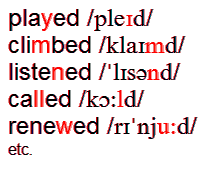
When is a verb ending in -ed pronounced
/d/, /t/ or /Id/?
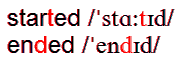
In verbs ending in /-t/ or
/-d/, the final -ed of the past simple and the past participle is pronounced
/Id/:
In verbs ending in a voiceless consonant, the final -ed is pronounced
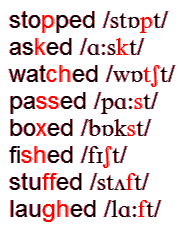
/t/.
The voiceless consonants that can appear at the end of a verb (except
/t/) are:
/p/, /k/, /tS/, /s/, /S/, /f/:
NOTE: the sounds /T/ and
/h/ are also voiceless, but they
rarely appear at the end of English verbs:
mouth (n.) /maUT/
mouth (v.) /maUD/
mouthed (v.) /maUDd/
teeth (v.) /ti;T/
teethed (v.) /ti;Tt/
In all other verbs ending in -ed (verbs ending in a voiced consonant or a vowel),
the final -ed is pronounced /d/:
Here is a more comprehensive
tutorial: how to pronounce final -ed.
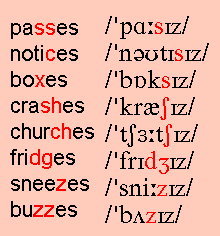
When is a word ending in -s or -es pronounced
/s/, /z/ or /Iz/?
The suffix -s or -es is found in verbs (in the 3rd person singular form of the present simple) and in plural nouns.
In words ending in sounds similar to /s/,
like /s/, /z/, /S/, /Z/, /tS/ and /dZ/,
the final -es is pronounced /Iz/:
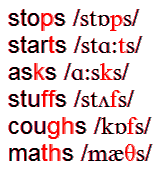
In verbs and nouns ending in a voiceless consonant (except
/s/, /S/, /tS/), the final -s is pronounced
/s/.
The voiceless consonants that can appear at the end of a verb or a noun are:
/p/, /t/, /k/, /f/;
/T/ can also appear at the end of nouns:
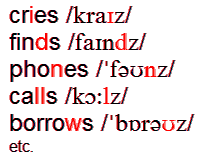
In all other verbs and nouns ending in -s (words ending in a voiced consonant or a vowel),
the final -s is pronounced /z/:
What is the difference between English and Spanish sounds?
Read these notes to contrast the English and Spanish phonemes.
Are there any rules to pronounce the vowels in English?
No, there aren't.
However, you can follow this link to see some very general rules about
how vowels are often pronounced in English.
When is an N pronounced as /N/?
Read these classnotes about velar /N/
to find out the answer.
You can also do this exercise to practise (but read the classnotes first!)
Present perfect / present perfect continuous
What's the difference between "I have worked" and "I have been
working"?
The present perfect is used for:
A finished action:
An action that may not be too recent:
An action whose duration is important:
The present perfect continuous is used for:
-
An unfinished but repeated or long-lasting action:
A recent action:
An action whose duration is not important:
Like + V-ing / like + Vto-inf
What's the difference between "I like going" and "I like to go"?
When does the verb "have" need DO or DID?
(Puedes leer un resumen en español de cuándo se usa DO con el verbo
have).
The verb HAVE is really 4 different verbs:
- HAVE (="tomar", "tener" not = "poseer", etc.) is a main verb (it needs DO/DOES/DID in negative and interrogative):
Do you have tea with your breakfast? No, I don't have tea, I usually have coffee.
When do you usually have a shower?
- HAVE (GOT) (= "tener" = "poseer") is an auxiliary in the present (it can take N'T in the negative), but a main verb in the past:
- Present (like an auxiliary verb):
Affirmative: I have (got) a red car. / I've got a red car.
Negative: I haven't (got) a motorbike.
Interrogative: Have you got a motorbike?
- Past (like a main verb):
Affirmative: I had a tricycle when I was little.
Negative: I didn't have a bicycle.
Interrogative: Did you have rollerskates?
However, in formal or written English and in American English it is usually a main verb, even in the present:
Do you have a red car? No, I don't have a car, I have a motorbike.
- HAVE (GOT) TO (=tener que) is a modal auxiliary verb, but it usually behaves as a main verb,
except in affirmative sentences, where it behaves both as an auxiliary and as a main verb:
I've got to do some exercises, but I don't have to finish them today. Do you have to do them?
No, but I have to study for the exam.
In formal or written English and in American English it is also a main verb:
Do you have to finish that composition today? No, I don't have to finish it today, but I have to finish it by Thursday.
- HAVE + past participle is an auxiliary verb (=haber):
I have done the first exercise. I haven't done the second exercise. Have you done it?
I had seen that film before. Had you seen it?
When is the verb "have" followed by GOT?
- We normally use GOT when it is difficult to distinguish between HAS and IS, for example, when HAS (or HAVE) is contracted:
He's a very nice dog. = Es un perro muy majo.
He's got a very nice dog. = Tiene un perro muy majo.
They're very good friends. = Son muy buenos amigos.
They've got very good friends. = Tienen muy buenos amigos.
The captain says the sergeant's to see him immediately. = Dice el capitán que el sargento ha de verle inmediatamente.
The captain says he's got to see you immediately. = Dice el capitán que tiene que verte inmediatamente.
- In colloquial British English you can omit GOT in questions (in the present only):
Have you a pen?
- In colloquial American English you can omit HAVE in questions (in the present only):
You got a pen?
What's the difference between "on", "in" and "at"?
Prepositions can have a lot of different meanings, and they are often different in Spanish and English. Look at these examples:
un vaso de vino = a glass of wine
una carta de Londres = a letter from London
un libro de animales = a book about animals
Each preposition has its own "collocations" (the words that appear together in a sentence), and often there are no rules:
we have to learn how to use each one, what words it collocates with, and how their meanings change.
In the case of "on", "in" and "at", there are two main cases: when they are place prepositions and when they are time prepositions:
- Time prepositions (preposiciones de tiempo):
ON: days of the week: on Monday, on weekdays; specific dates: on the eleventh, on Christmas Eve.
IN: months: in March; years: in 1999; seasons: in the winter; parts of the day (except "at night"): in the morning; historical periods: in the Bronze Age.
AT: times: at six o'clock, at midnight; periods of time that have a name: at Christmas, at Easter, at the weekend.
Other uses:
IN = dentro de: in two hours
AT = en: at present, at the/this moment (=en este momento, actualmente), at the/that time (=en aquella época)
ON = en, a: on some occasions (=el algunas ocasiones), on the next morning (=a la mañana siguiente)
- Place prepositions (preposiciones de lugar):
General meanings:
ON = encima de, pegado a: on the table, on the wall, on the ceiling
IN = dentro de: in the box, in the kitchen, in Scotland, in London, in hospital (ill).
AT = en (when it is obvious it is inside a building, a workplace, or at home): at home, at work, at school, at the hospital (working)
Descriptions:
AT: at the top / at the bottom / at the background
ON: on the right / on the left (pero TO the right of / TO the left of)
IN: in the middle / in the top right corner
Means of transport:
ON: on a bus, on a train, on a plane, on a bicycle, on a horse, on foot
IN: in the car, in a taxi, in a helicopter
AT: at the bus-stop, at the station
Other uses:
IN: in Oxford Street, in the newspaper, in the sky
AT: at 36 Cambridge Street
ON: on TV, on the radio, on the Internet, on page 10
When should I use "for" and "to" when I mean "para"?
- Use TO / IN ORDER TO / SO AS TO in front of a verb (in the infinitive):
Click on the icon to see the image.
= Pincha en el icono para ver la imagen.
In order to solve this problem we need to work together.
= Para resolver este problema necesitamos trabajar juntos.
We must meet again so as to agree on a plan of action.
= Necesitamos reunirnos de nuevo para acordar un plan de acción.
- For negative sentences, use IN ORDER NOT TO / SO AS NOT TO in front of a verb
(in the infinitive):
We will need to rest in order not to get exhausted.
= Necesitaremos descansar para no agotarnos.
They were walking in the river so as not to leave any footprints.
= Iban caminando por el río para no dejar huellas.
- Use FOR in front of a noun or pronoun:
I have some good news for your mother.
= Tengo buenas noticias para tu madre.
This present is for you.
= Este regalo es para ti.
- Use SO THAT in front of a full sentence (with a subject and a verb);
the verb in the second sentence is not always translated literally in Spanish,
and very often we use CAN:
Come early so that you can find good seats. (= podáis encontrar)
= Venid temprano para que encontréis buenos asientos.
Hold on tight so that you won't fall. (= "caerás")
= Agárrate fuerte para que no te caigas.
- You can use FOR in front of a verb (in the GERUND) when you are defining what something is
used for (but you can also use TO plus a verb in the infinitive for this):
A computer is used for making fast calculations.
= Un ordenador se usa para hacer cálculos rápidos.
A computer is used to make fast calculations.
= Un ordenador se usa para hacer cálculos rápidos.
When should I use "another" instead of "other"?
You can read some class notes and examples about other / another
here.
Personal pronouns and possessives
If you need to practise, here you can download
a .pdf worksheet with classnotes and exercises about subject and object pronouns and possessive
adjectives and pronouns. You can ask your teacher to correct these exercises when you finish them.
Yet / still / already
Here are some classnotes to practise how to use yet /
still / already.
This is an exercise
about yet / still / already.
Since / for / during / ago
First, read these classnotes about since / for
/ during / ago.
Then, do this exercise about since / for / during / ago.
Articles — the / Ø / a / an, + some / any
Here is a .pdf worksheet with classnotes and exercises about
articles.
Here are some class notes with a summary on the use of A / AN / SOME / ANY.
something / anyone / everybody ...
Here are some class notes about compounds of SOME / ANY / NO / EVERY.
How do I transform a sentence to make it negative or interrogative?
Here are some classnotes about making
sentences negative, and here are others about
making sentences interrogative.
También podéis trabajar con estos videotutoriales
en español.
(= You can also work with these videotutorials in Spanish.)
Where can I get some help about basic verb tenses?
Here are some classnotes about basic verb
tenses.
Here is a really basic summary of basic verb
tenses in a nutshell.
Where can I learn all the verb tenses?
Here is a simple verb tenses chart
that will help you learn all the names and forms of the main verb tenses.
How can I learn about the present simple?
Here are some classnotes in a .pdf document.
There are also some exercises, but you will need your teacher to correct them.
How can I learn about the present continuous?
Here are some classnotes in a .pdf document.
There are also some exercises, but you will need your teacher to correct them.
How can I learn about the past simple?
Here are some classnotes in a .pdf document.
There are also some exercises, but you will need your teacher to correct them.
How can I learn about the past continuous?
Here are some classnotes in a .pdf document.
There are also some exercises, but you will need your teacher to correct them.
How can I learn about the present perfect?
Here are some classnotes in a .pdf document.
There are also some exercises, but you will need your teacher to correct them.
How can I learn about the future tenses?
Here are some classnotes in a .pdf document.
There are also some exercises, but you will need your teacher to correct them.
Where can I get some detailed help about past tenses?
Read these classnotes about past tenses (past simple, past continuous, present perfect, past perfect).
Where can I get some help about word order?
Here are some classnotes about word order
in Spanish for a basic introduction to English grammar. These are intended to be used in the classroom,
with your teacher's help.
If you are at home, here are some classnotes and short exercises about word order
in Spanish that you can use on your own to learn and practise a bit.
Wh-words
Here is a glossary of the 8 wh-words in English, and another 8 two-word combinations.
Where can I get some help about wh- questions?
Here is some help if you have problems to understand how interrogative sentences work
(you can also read these classnotes in Spanish).
When you are ready, do these exercises and check your answers with the answer key provided.
Still not sure? If you need more practice, download some
extra exercises about wh- questions with an answer key so that you can correct them yourself.
You can also use an
action
maze tutorial about transforming affirmative sentences into interrogatives.
How does the passive voice work?
Watch these passive voice videotutorials; you can also do some of the exercises on your own.
Use these classnotes and exercise to learn how to transform a simple sentence into the passive voice.
You can also check the bilingual section classnotes.
How does reported speech work?
Watch or read these reported speech videotutorial and tutorials;
you can also do some of the exercises on your own.
In these reported speech tutorials
you will find classnotes about reported speech (or indirect speech), and some exercises (without the answer key,
so you will need to ask your teacher to correct your answers).
There are several separate pages, but you can have them all in this document
about estilo indirecto (en español), where you will be able to see all the answers.
To understand how reported speech works, you can use this
reported speech reference document in English if you find it useful.
You can also download a summary — a 4-page document (in Spanish) with
all the rules and many more exercises. If you are working in the summer and your teacher cannot help you, you can also
download the answer key.
If you want to learn about reported speech in depth and do some intensive practice, you can use these
full classnotes (in Spanish) with complete classnotes and exercises,
plus the answer key so that you can correct your answers (14 pages, 155 Kb).
What is the difference between reported speech and passive voice?
Read these classnotes to contrast both types
of transformations.
How are question tags used?
Here are some classnotes in English,
and some exercises that you can do online:
exercise 1
exercise 2
exercise 3
exercise 4
You can also download the version in Spanish (it is not exactly the same,
though).
How do relative clauses work?
Read these classnotes for explanations and
examples.
What are conditional sentences like?
Here are some conditional
sentences classnotes, with examples of the most typical conditional sentences, some less common
types, and a couple of special cases.
When is a verb followed by a gerund or an infinitive?
Here are some basic classnotes about the uses
of the gerund and the infinitive.
When a verb comes after a certain verb it can take three forms: gerund, bare infinitive (without TO),
or infinitive with TO. Sometimes there are two possibilities, with or without a change in meaning.
Here is a .pdf list of examples with verbs followed by other verbs
that you can refer to when you are in doubt; it is not complete, but it includes many of the
most common English verbs.
What is the difference between "need", "must" and "have to"?
You can read these classnotes about NEED,
MUST and HAVE TO.
Where can I get some detailed help about other modal verbs?
Here are some links to class notes and exercises about modal verbs
and a modal verbs chart
with examples.
Where can I get some help about comparative and superlative adjectives?
Here are some classnotes about comparative
and superlative adjectives. You can also do some
exercises here.
How can I know when a verb does not need to change in reported speech?
In reported speech exercises you have to assume that a long time has passed from the time someone said
something to the moment when you tell someone else about it. Then, you have two options:
either to study the context and decide how long is "a long time", and then imagine that is
how long has passed between the two conversations; or, more simply, to follow the rule strictly
and change all the verb tenses that can be changed. Even if it is very obvious that there is no
need to change a specific verb, it is not wrong if you change it:
He asked me what my name was. = Me preguntó cómo me llamaba. → obviously your name
hasn't changed, but you can still change the tense.
Green up arrow icon source:
commons.wikimedia.org

|