
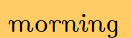
 morning morning
Nota: si no ves la palabra de la izquierda como la de la derecha,
descarga y copia el tipo de letra
Latin Modern Roman Unslanted
en C:\Windows\Fonts (en Linux suele venir instalada).
Hemos elegido este tipo de letra porque es más fácil de leer para
quien, como yo, confunde una M con una R seguida de una N cuando son minúsculas.
Si prefieres otro tipo de letra, puedes probar con Aladin,
con Cookie o con Alice:
la fuente que instales en tu ordenador será la que se verá.
Si prefieres otra fuente distinta, copia los ficheros de esta carpeta a tu disco duro
y cambia los nombres de los tipos de letra en este fichero;
luego guárdalo en la misma carpeta donde hayas copiado los demás ficheros.
|
|
VIDEOTUTORIALES
ÍNDICE GENERAL
CÓMO CONVERTIR ORACIONES AFIRMATIVAS EN PREGUNTAS (YES-NO questions)
a) Oraciones con auxiliar:
| A1.1 |
IS |
Is the cat on the rug? |
| A1 |
IS |
Is this your cat? |
| A1.1 |
ARE |
Are the flowers on the table? |
| A1 |
ARE |
Are they at school? |
| A1 |
AM / IS / ARE |
Am I a good student? |
| A1 |
WAS / WERE |
Was I/he/she/it in the kitchen?
Were you/we/they in the garden? |
| A2 |
BE |
ser — estar |
| A1.1 |
THERE IS |
Is there a cat? |
| A1 |
THERE IS |
Is there any wood? |
| A1.1 |
THERE ARE |
Are there any animals? |
| A1 |
THERE WAS / THERE WERE |
Was there a blue car?
Were there a lof of people? |
| A1 |
Present continuous |
Am I talking too much? |
| A1.1 |
Present continuous |
Is the dog eating a bone? |
| A1.1 |
Present continuous |
Are they playing? |
| A1 |
Present continuous |
Is he/she/it sleeping? |
| B1.1 |
Present continuous for plans |
Are we meeting at six? |
| B1.1 |
Future simple |
Will he help you? |
| A2 |
BE GOING TO |
Are you/we/they going to stop? |
| A1 |
HAVE (GOT) |
Have I/we/you/they got an exam? |
| A1 |
HAS (GOT) |
Has he/she/it got got long hair? |
| A1 |
Past continuous |
Was I/he/she/it sleeping? |
| A1 |
Past continuous |
Were you/we/they working? |
| A2 |
Present perfect |
Have I/you/we/they finished?
has he/she/it woken. |
| B1 |
Past perfect, future continuous, conditional, etc. |
Those people had done nothing.
They will be lying in the sun.
He would help you if he could. |
b) Verbos auxiliares modales:
| A1.1 |
CAN |
Can birds fly? |
| A1 |
CAN |
Can he swim? |
| A1 |
MUST |
Must I study? |
| A1 |
HAVE TO |
Do we have to go so soon? |
| A1 |
SHOULD |
Should he rest? |
| A1 |
COULD |
Could it freeze tonight? |
| B1.1 |
MIGHT |
Might they come? |
| B1.1 |
MAY | May they come in now? |
c) Tiempos verbales simples
(sin auxiliar en afirmativa):
CÓMO CONVERTIR ORACIONES AFIRMATIVAS EN NEGATIVAS
| A1 |
BE NOT
(isn't, wasn't, won't be) |
It isn't raining. |
| A1 |
Present simple (do not) |
I don't know. |
| A1 |
Present simple (does not) |
He doesn't live here. |
| A1 |
Past simple (did not) |
They didn't do it. |
| A1 |
HAVE NOT
(haven't, don't have) |
I haven't a clue. |
| A1 |
HAS NOT
(hasn't, doesn't have) |
He doesn't have a wife. |
| A1 |
DID NOT HAVE |
They didn't have a job. |
| A2 |
Tiempos sin auxiliar (do/does/did not) |
My fish don't/doesn't/didn't look healthy. |
| A1 |
Exam 3 |
Affirmative → negative & interrogative |
| A1 |
Exam 4 |
Affirmative → negative & interrogative |
CÓMO HACER PREGUNTAS ESPECÍFICAS
(WH-QUESTIONS)
| A1 |
Where |
Where am I? |
| A1 |
When |
When is your birthday? |
| A1 |
What |
What do you mean? |
| A1 |
Who |
Who is that girl? |
| A1 |
Why |
Why is she crying? |
| A1 |
How |
How are you? |
| A1 |
How much |
How much is it, please? |
| A1 |
How many |
How many apples do you want? |
| A1 |
Which |
Which colour do you prefer? |
| A1 |
How old |
How old are you? |
| A1 |
Whose |
Whose is this notebook? |
| A1 |
How often |
How often do you have a shower? |
| A2 |
How long |
How long have you lived here? |
FONÉTICA BÁSICA
| A2 |
Pronunciación de -s |
/z/, /s/, /Iz/ |
| A2 |
Pronunciación de -ed |
/d/, /t/, /Id/ |
| A2 |
Vocales y diptongos I |
/eI/, /aI/, /I/, /i;/ |
| A2 |
Vocales y diptongos II |
/aU/, /@U/, /O;/, /u;/ |
| A2 |
Consonantes I |
/T/, /D/ |
FONÉTICA AVANZADA
| B1 |
Consonantes II |
/n/, /N/ |
| B1 |
Vocales III |
/3;/, /e/, /&/, /V/, /A;/, /O:/ |
| B1 |
Otros fonemas |
/S/, /ju:/ |
CÓMO CONVERTIR ORACIONES ACTIVAS EN PASIVAS
| A2 |
Pasivas I: Od → S |
America was discovered in 1492. |
| B1 |
Pasivas II: Oi → S |
My brother was given a book. |
| B1 |
Pasivas II: Oi → S (práctica extra) |
Hitchcock was given a prize. |
| B1 |
Pasivas III |
I must have it revised. |
CÓMO USAR EL ESTILO INDIRECTO
| B1 |
Estilo indirecto I: introducción + deícticos |
He said they live there. |
| B1 |
Estilo indirecto II: personas |
He says she is his wife. |
| B1 |
Estilo indirecto III:
tiempos verbales |
He said he was rich. |
| B1 |
Estilo indirecto IV: expresiones de tiempo |
He said he had arrived the day before. |
| B1 |
Estilo indirecto V: preguntas |
He asked where I lived. |
| B1 |
Estilo indirecto VI: exhortaciones |
He asked me to come. |
| B1 |
Estilo indirecto VII: auxiliares modales |
He said I had to stop smoking. |
| B2 |
Estilo indirecto
+ voz pasiva IV |
I was told to wait here. |
| B2 |
Estilo indirecto
+ voz pasiva V (Vto+inf) |
He is said to be rich. |

|
|
|
JJCC
|