Back to index
The passive
- To make a sentence passive we need to do this:
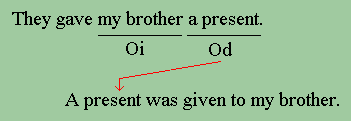
- Identify the direct object in the active sentence to use it as the subject in the passive.
If there is an indirect object, it is always preceded by "to" or "for" in the passive sentence:
Example:
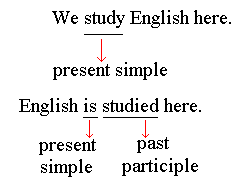
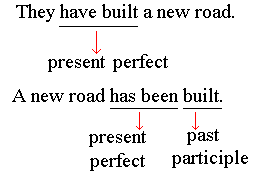
- Put the active verb in the passive. To do this, we replace the main verb with be, in the same tense as the main verb (with the same auxiliaries);
then we add the past participle of the main verb.
Examples:
Remember to check if the first auxiliary has to be changed because the subject has changed:
- Add the rest of the active sentence. If the agent is important, we include it after by. If it isn't important, it isn't included.
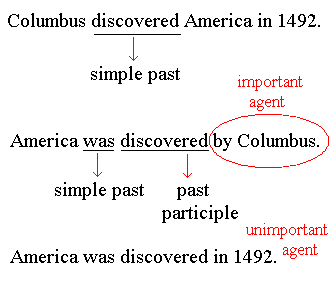
- Therefore, there are two reasons to use the passive in English:
- To highlight a very important subject, turning it into an agent at the end of the sentence, which is where the most important information is usually found.
- To omit a subject which is not important or not known, turning it into an agent which can be omitted (because we can't omit the subject in English).
- As a result, passives in English are much more common than in Spanish, because in Spanish we can use other strategies or structures:
- Changing the position of the object and the subject in an active sentence:
Este cuadro lo pintó mi tío David. = This painting was made by my uncle David.
Mi móvil lo eligieron mis padres. = My mobile was chosen by my parents.
- Using an impersonal "se" pronoun:
Se necesita más información. = More information is needed.
Se esperan más lluvias en el norte mañana por la mañana. = More rain is expected in the north tomorrow morning.
- Omitting the subject:
Publicaron la noticia ayer. = The news was published yesterday.
Han vendido todas las entradas. = All the tickets have been sold.
- Using other verbs which require a passive structure in English:
Hay que terminar este informe hoy. = This report must be finished today.
Han resultado muertos en un accidente. = They have been killed in an accident.
Nació en un barco. = He was born on a boat.
Está acusado de asesinato. = He has been charged with murder.
© Juan José Castaño