Back to index
Contrasting the passive voice & reported speech


Look at the way an active transitive sentence can be transformed into a passive sentence or into reported speech:

'I have declared Jerusalem the capital of Israel', Donald Trump said.

Jerusalem has been declared the capital of Israel (by Donald Trump).
---> passive — we want to omit the agent (because it is not the important information) or highlight it.

Donald Trump said he had declared Jerusalem the capital of Israel.
---> reported speech — we repeat someone's words, but not literally.

(We can also transform a sentence in the passive voice into reported speech, or viceversa; the result is the same:
Donald Trump said Jerusalem had been declared the capital of Israel.)

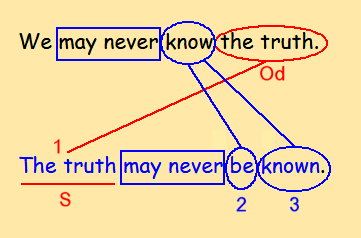
Let's revise how these transformations are done. In the example below, there is only one verb:

From active to passive voice From direct to reported speech

  1. We use the direct object (Od) as the subject (at the beginning of the sentence).

  2. We replace the main verb with the verb BE, in the same tense.

  3. We add the past participle of the main verb.

  1. We replace pronouns, possessives, time expressions and demonstratives that refer to a different person, time or place.

  2. We "move" the tense back in time: from present to past, from past to past perfect, from future to conditional.


In the following example, the verb includes an auxiliary (and a frequency adverb, which is in adverbial position —after the first auxiliary— and therefore it behaves like another auxiliary):

From active to passive voice From direct to reported speech

  1. We use the direct object (Od) as the subject.

  2. We replace the main verb with the verb BE, in the same tense (and therefore, with the same auxiliaries).

  3. We add the past participle of the main verb.

  1. We replace pronouns, possessives, time expressions and demonstratives that refer to a different person, time or place.

  2. We "move" the tense of the first auxiliary back in time: from present to past, from past to past perfect, from future to conditional.


Remember: For the passive voice, change the main verb.
For reported speech, change the first auxiliary.

Look at some other examples in different tenses (you can copy them and then draw the coloured lines in your notebook). In these examples, the verb includes an auxiliary and an adverb in adverbial position (after the first auxiliary) which behaves as if it were another auxiliary:

From active to passive voice From direct to reported speech
You are also forgetting something important.

Something important is also being forgotten.
'You are also forgetting something important', he said.

He told me I was also forgetting something important.
He told us we were also forgetting something important.
Remember that in English you can also use the indirect object as the passive subject:

I will soon give you your money back.

You will soon be given your money back.
Your money will soon be given back to you.
Remember to check the context for information about who and what pronouns and possessives refer to:

'I will soon give you your money back', he said.

He told me he would soon give me my money back.
He told us he would soon give us our money back.
We are beginning to study your problem now.

The problem is beginning to be studied now.
'We are beginning to study your problem now,' he said.

He told me they were beginning to study my problem then.
He told us they were beginning to study our problem then.


Get some advanced extra practice turning the sentences below into the passive voice and reported speech (drag the mouse over the space between the square brackets to see the correct answers). Sometimes it is not strictly necessary to change the tenses in reported speech, because the sentences are still true a long time after they were said.

  1. Climage change caused a tornado in Germany in May 2018.
    Passive voice: [A tornado was caused by climate change in Germany.]
    Reported speech: They said [climate change had caused a tornado in Germany.]

  2. We should take these events into consideration.
    Passive voice: [These events should be taken into consideration.]
    Reported speech: She said [they should take those events into consideration.]

  3. Mankind will always find fascinating mysteries beyond all known frontiers.
    Passive voice: [Fascinating mysteries will always be found beyond all known frontiers.]
    Reported speech: The scientist said [mankind would / will always find fascinating mysteries beyond all known frontiers.]

  4. It was inevitable: we had taken all possible precautions.
    Passive voice: [It was inevitable: all possible precautions had been taken.]
    Reported speech: The minister claimed [it was inevitable, because they had taken all possible precautions.]

  5. Shall we make all the arrangements for the meeting this evening?
    Passive voice: [Shall all the arrangements for the meeting be made this evening?]
    Reported speech: She asked [whether / if they should make all the arrangements for the meeting that evening.]

  6. What can we do about it?
    Passive voice: [What can be done about it?]
    Reported speech: He asked them [what they could do about it.]

  7. Do people really understand this phenomenon?
    Passive voice: [Is this phenomenon really understood?]
    Reported speech: He wondered [whether /if people really understood that phenomenon.]

  8. They asked me to give a speech about my academic life here today.
    Passive voice: [I was asked to give a speech about my academic life here today.]
    Reported speech: He said [they had asked him to give a speech about his academic life there that day.]

  9. If a boy does not respect his girlfriend, he can't say he loves her.
    Passive voice: [If a girl isn't respected by her boyfriend, he can't be said to love her.] ¹
    Reported speech: The priest said [if a boy didn't respect his girlfriend, he couldn't say he loved her. / if a boy doesn't respect his girlfriend, he can't say he loves her.]

  10. We must not take democracy for granted.
    Passive voice: [Democracy must not be taken for granted.]
    Reported speech: He declared [ we should not / must not take democracy for granted.] ²
¯¯¯¯¯¯¯¯¯¯¯¯¯
¹ In this sentence we should not begin with "If his girlfriend..." because we do not know who he is yet. There is also a more natural way of starting rather than "If a girlfriend..."
² In the last sentence we cannot use "didn't have to" because "not have to" (= it is not necessary) is not the same as "must not" (= it is not allowed / advisable). The closest modal verb we can use here is "should", because the sentence is really a piece of advice rather than a prohibition.


Have you noticed there are no directives (sentences like commands, advice, offers,...) among the sentences above? That is because they are common enough in reported speech, but it is very rare to find a directive in the passive voice:

Let's find an alternative solution.
Reported speech: He suggested finding an alternative solution.
Passive voice: Let an alternative solution be found.

Back to index

© Juan José Castaño