
Content and Language Integrated Learning
|

CLIL: Content and Language Integrated Learning.
AICLE: Aprendizaje Integrado de Contenidos (no lingüísticos) y Lengua Extranjera
- The main focus is in the integration of two types of learning.
___________________
¹ Marsh, D (Ed) (2002) CLIL/EMILE - The European Dimension: Actions, Trends and Foresight Potential. Public Services Contract DG EAC: European Commission
David Marsh, of the University of Jyväskylä, Finland, is a leading expert on Clil in Europe: Interview with David Marsh (offline)
Index
- Traditional approaches (grammar-translation, communicative, functional-notional, total physical response): learning English in Spanish.
- CBI (content-based instruction): learning English as a foreign language (EFL) by studying other subjects in English.
- TBLT (task-based language teaching): learning English through projects and group work.
- Immersion method: learning English as a second language (ESL) IN English (in an English-speaking country).
- CLIL: learning content THROUGH English AND learning English by learning other subjects in English.
Motivation for students:
- They learn English more efficiently by using the language in the content subject classroom than by means of explicit language teaching:
- Communicative competence increases.
- Input is meaningful (in a real context) and comprehensible (just a bit above their level, but they can understand it).
- Visual aids help students understand input.
- Students can concentrate on the information (relevant, interesting), not on its form (boring).
- Communicative competence increases.
- Motivation to learn English increases: it helps them learn other subjects.
- Motivation to learn other subjects increases: it helps them learn English.
- (In other countries) They get reduced groups.
- (In other countries) They get a considerable rise in salary.
- They get groups of good students.
- They get a professional challenge:
- For content teachers: the opportunity to use and learn English.
- For English teachers: the opportunity to refresh their methodology, create new materials, work in new ways.
- For content teachers: the opportunity to use and learn English.
| Other methods | CLIL |
|
|
|
|
|
|
|
|
|
|
|
|
|
|
|
|
Index
- Using English exclusively is by no means essential.
«Integrated» learning means using the first language when it is appropriate in the teacher's opinion
(for example, after several attempts at explaining the meaning of a word in English have failed).
- Learning does not depend solely on the amount of hours spent working in English
(the most usual ratio is around 50% of the week's lessons in English);
the quality of the input and the classroom activities are more important.
- "Successful language learning can be achieved when people have the
opportunity to receive instruction, and at the same time experience real-life
situations in which they can acquire the language." (Marsh, 14_1UK.pdf, pp. 2-3)
- Finding, processing, transforming and presenting information via TICs is a key task.
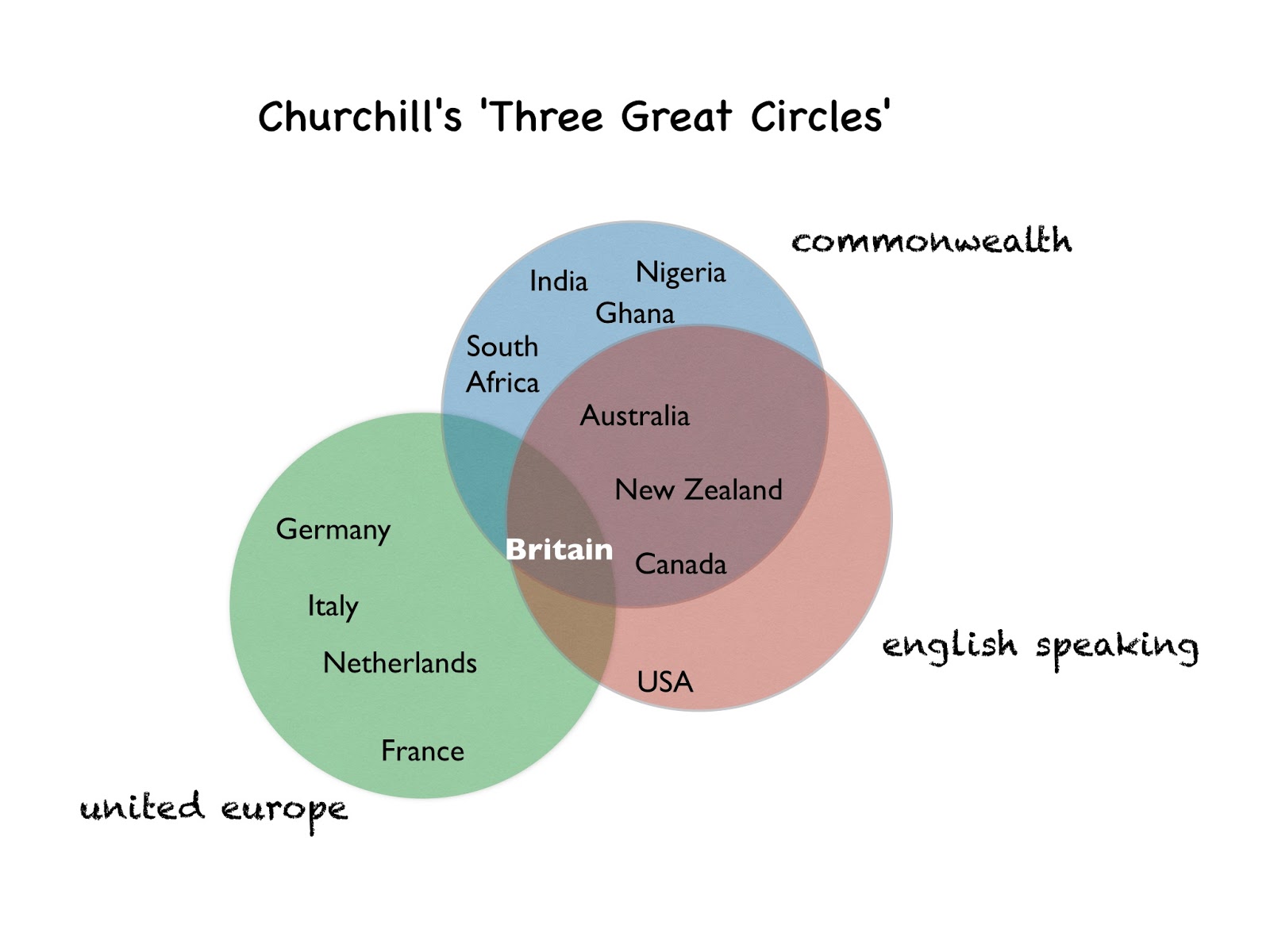
An illustrative example of a Venn diagram: Churchill's "three great circles".
A humourous example of a Venn diagram: contrasting features
A satyrical example of a Venn diagram: social software
A humouristic example of a Venn diagram: my sense of humour
A practical example of a didactic activity using a Venn diagram
Index
The teacher should make sure the students understand what he is saying without using Spanish if possible, using these techniques:
- Use language which is a bit above the level of the students, i.e., using every day a few words which the students do not know.
- Limit lecture-type presentations in frequency and length.
- Encourage students to make contributions and express their own ideas.
- Use graphs, pictures or video to make it easier for students to understand information.
- Use gestures to clarify the meaning of some words or correct mistakes.
- Avoid correcting grammar or pronunciation mistakes that do not affect meaning. Only those mistakes which make understanding difficult, such as using the wrong tense or word order when it affects meaning, should be corrected. The teacher should concentrate on content, not correct language use.
- Provide relevant background and context, and explain new concepts or ideas several times using slight variations in terminology and examples.
- Spend some time defining, discussing, and clarifying new words before students have to deal with them in a text or an activity. This is especially helpful for students who have more problems to understand English.
Teaching materials used in bilingual programmes often do not adhere to the best CLIL principles. Coyle (1999, 2006) set up the «4Cs framework», which determines what CLIL materials should include. This framework applies especially to English teachers, because they have more freedom to select specific contents and materials, but content teachers can also benefit from it.
| (knowledge and skills) | Learners need to create their own knowledge and understand and develop skills (personalised learning). |
|
(learning and thinking) | The contents need to be analysed in terms of their linguistic demands. |
| (interaction in the foreign language) | Learning the language that is related to the learning context is fundamental to learning. |
| (intercultural awareness) | Awareness of the relationship between the culture and the language. |
Index
- Input should be:
- meaningful
- motivating
- authentic
- challenging
- multimodal
Index
Scaffolding refers to several ways of support in the learning materials that can help learners understand the information they need to carry out a task, even when the authentic text they are reading has many new words which they do not understand. Students who are not as gifted as others in language learning greatly benefit from scaffolding.
- Structured tasks and questions.
- Language support.
- Learning skills practice.
Index
(These tips refer especially to CLIL English lessons).
- Language acquisition is strongly facilitated by the use of the target language in interaction (Long 1996).
- Learners need to be pushed to make use of their resources; they need to have their linguistic abilities stretched to their fullest,
they need to reflect on their output and consider ways of modifying it to enhance comprehensibility, appropriateness and accuracy.» (Swain, 1993: 160f.).
- Student interaction and output is triggered by tasks,
which is why task design is at the heart of every CLIL lesson
and one of the key competences for every CLIL teacher.
- Languages are acquired most successfully when they are learned for communicative purposes in meaningful and significant social situations,
so Task-Based Language Teaching should be an integral part of CLIL:
Sample task #1
Sample task #2
- One of the core-features of TBLT is the so-called gap-principle. It states that authentic
communication will occur when there are certain communication gaps which need to be bridged by the students:
- Information gap: transferring information from a text to a table or from one pupil to another.
- Reasoning gap: deducing a teacher's timetable from a set of class timetables
or working out an optimum course of action given different variables.
- Opinion gaps: completing a story and comparing endings.
- Information gap: transferring information from a text to a table or from one pupil to another.
- Task-repetition is another very efficient way to promote communication skills:
Task repetition sample task structure
- Giving students previous planning time is likely to increase accuracy and complexity,
while reduced planning time is likely to result in more fluency but less accuracy and complexity
(Ellis, 2003).
- The relationship between CLIL and TBLT is symbiotic: authentic and meaningful content
is used to create motivating and challenging tasks. Authentic communication in different
cooperative formats (like think-pair-share activities) triggered by those tasks and the
frequent negotiation of meaning necessary to complete them enables a greater depth
and bandwidth of content learning.
- There is no need for tasks to be as comprehensive and time-consuming as the ones listed above.
Authentic communication can be achieved in short periods of valuable teaching time when:
- Students draw a graph based on sharing information.
- Students sit back to back and are asked to spot mistakes in pictures handed to them without showing them to each other.
- Students create L2 subtitles or an audio track for an L1 video clip or vice versa using software like Microsoft Moviemaker or similar freeware.
- Students draw a graph based on sharing information.
(This strategy refers especially to CLIL English lessons).
A real-life example:
Once I wanted to ask a young English person for directions. He was standing near a queue inside a McDonald's. I walked up to him from his back, refrained from tapping his shoulder and said "Excuse me?" instead, as I had been taught one should do when one wants to ask a question to a British person. Guess what happened next (drag the cursor between the square brackets to read it):
Index
Of the approximately 80,000 questions asked on average annually by teachers, 80 per cent are at the lowest level of thinking — factual knowledge.
The core elements of CLIL (input, tasks, scaffolding and output — see graph below) have to be balanced to include not only systematic language work, but also several cognitive activities (understand, synthesise, evaluate, create, etc.), in order to achieve competence in academic language use —the knowledge and mastery of academic forms of communication and of writing in particular.

BICS = Basic Interpersonal Communication Skills
CALP = Cognitive Academic Language Proficiency
In CLIL, sustainable teaching and learning is of great importance. Teachers have to facilitate both the learning of the specific content and the learning/acquisition of a foreign language. In addition to that, they have to find ways of making sure that the students can talk about the respective topics in both their L1 and their L2.
Index
Sample unit contents chart
|
|
||||
 |
|
|
|||
|
|
||||
|
|
||||
|
|
||||
|
|
||||
Another practical guide to preparing a CLIL lesson (by Steve Darn)
Index
In David Marsh's words, "every country in Europe is moving on Clil to a greater or lesser extent, except Iceland, Portugal and Greece. If you look at how this Clil movement has been coming, it has been grassroots, bottom-up [i.e., demanded by families and schools and then supported by authorities] in the majority of countries. And that makes it quite a formidable force."
In contrast with this, "in a few countries", including Spain, it has been a top-down policy: imposed by educational authorities who showed little regard for the CLIL principles, on teachers who had had no previous training in CLIL, and severely limited in its scope and resources, aiming at a small number of schools, then expanding to other schools but with ever-decreasing resources.
The main consequences of this policy can be seen in the following problems:
- Official instructions do not always follow the basic guidelines of CLIL:
- Official evaluation of the bilingual programs is inadequate:
- Education authorities do not provide enough resources:
- On the one hand, they keep restricting the human and material resources that are necessary:
- On the other hand, they make more and more demands on the teachers:
- On the one hand, they keep restricting the human and material resources that are necessary:
Our CLIL project (offline full version)

 Our CLIL project (online summary)
So far we have tried to do too much in our school with diminishing resources. We have achieved a lot, but there is still a lot more that could be done:
- Designing and using CLIL didactic modules that adhere to the principles of CLIL: the four C's, richer input, scaffolding for output, ...
- Increasing co-ordination with the English teachers to design scaffolding activities in content lessons.
- Designing didactic modules for the English class based on content from the other subjects.
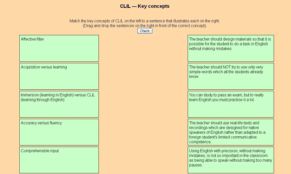
ACTIVITY 4
Index
- 6_DavidMarsh.txt: An introduction to CLIL — interview with David Marsh for the Guardian Weekly
- 14_1UK.pdf: An introduction to CLIL, by David Marsh
- 14_3Esp.pdf: A Spanish translation of the previous one.
- 10_Dialnet-TowardsQualityCLIL-3311569.pdf: basic strategies for making CLIL materials
- 22_CLIL_A_lesson_framework.txt
- 1_ManualLanguageTest-Alte2011_EN.pdf
www.coe.int/.../ManualLanguageTest-Alte2011_EN.pdf
www.coe.int/...Manuel1_EN.asp#Manual_test
Manual for Language Test Development and Examining - Council of Europe
- 2_GuideEPI2010_EN.pdf
www.coe.int/.../GuideEPI2010_EN.pdf
http://www.coe.int/T/DG4/Linguistic/Default_en.asp
Guide for the development and implementation of curricula for plurilingual and intercultural education
Council of Europe
- 3_Framework_EN.pdf
www.coe.int/.../Framework_EN.pdf
CEFR in English
Council of Europe
Full information about how the CEFR was worked out
- 4_cvc_mer.pdf
cvc.cervantes.es/.../cvc_mer.pdf
cvc.cervantes.es/.../marco/
MCER en español
Cervantes
- 5_ManualRevision-proofread-FINAL_en.doc
www.coe.int/.../ManualRevision-proofread-FINAL_en.pdf
www.coe.int/.../Manuel1_EN.asp
Manual for relating Language Examinations to the Common European Framework of Reference for Languages (CEFR)
Council of Europe
- 6_DavidMarsh.txt
www.theguardian.com/...html
- 7_debate_2005.rtf
www.theguardian.com/...guardianweekly.guardianweekly13
CLIL Debate- Clil debate questions and answers - Guardian Weekly
- 8_Entrevista con Do Coyle. (1_7).mp4
www.youtube.com/watch?v=BcjdRldQNmo
Entrevista con Do Coyle (1/7) sobre lo que CLIL es
- 9_David_Marsh_on_CLIL.mp4
http://www.youtube.com/watch?v=-Czdg8-6mJA
David Marsh on CLIL (9 min.)
- 10_Dialnet-TowardsQualityCLIL-3311569.pdf
dialnet.unirioja.es/.../Dialnet-TowardsQualityCLIL-3311569.pdf
Towards quality-CLIL: successful planning and teaching strategies, by Oliver Meyer
CLIL strategies (CLIL foundations, rather dense and theoretical but with the aim of helping design CLIL activities)
- 11_slrcoyle.pdf
blocs.xtec.cat/.../slrcoyle.pdf
CLIL — Motivating Learners and Teachers, by Do Coyle
Extract from the «CLIL Teachers Tool Kit: a classroom guide», available from Do Coyle at do.coyle@nottingham.ac.uk
- 12_aprendizaje_cooperativo_5_pasos.txt
www.educacontic.es/.../aprendizaje-cooperativo-en-5n-pasos
Cómo usar el aprendizaje cooperativo
- 13_aprendizaje_cooperativo_como_empezar.txt
deestranjis.blogspot.com/.../aprendizaje-cooperativo-cmo-empezar.html
Cómo usar el aprendizaje cooperativo
- 14_1UK.pdf
14_3Esp.pdf
www.ecml.at/.../1UK.pdf
www.ecml.at/.../3Esp.pdf
The basics of CLIL (in English and in Spanish)
- 15_BBC_CLIL.txt
www.teachingenglish.org.uk/.../content-language-integrated-learning
The basics of CLIL, according to the BBC
- 16_BBC_CBI.txt
www.teachingenglish.org.uk/.../content-based-instruction
Content-Based Instruction (CBI), according to the BBC (British Council)
- 17_ED305824.pdf
17_resumen.txt
files.eric.ed.gov/.../ED305824.pdf
Training manual for CLIL (1989).
- 18_Perez_Torres_EuroCALL07.pdf
18_webquests.txt
sites.google.com/.../Perez_Torres_EuroCALL07.pdf
Isabel Perez's presentation on webquests
- 19_DAL_SGLE.PDF
www.univie.ac.at/.../DAL_SGLE.PDF
Academic paper on directives in the CLIL classroom
- 20_Views_18_3_2009_special_issue.pdf
typo3.univie.ac.at/.../Views_18_3_2009_special_issue.pdf
VIENNA ENGLISH WORKING PAPERS - special issue on CLIL
- 21_second_language_terminology.txt
www.everythingesl.net/.../essential_vocab.php
Understanding Second Language Terminology
- 22_CLIL_A_lesson_framework.txt
www.teachingenglish.org.uk/.../clil-a-lesson-framework
CLIL - A lesson framework - BBC & British Council
- 23_CLIL_handbook.odt
www.teachers.cambridgeesol.org/.../113848_5282_0Y01_TKT_CLIL_Handbook_w.pdf
- prezi.com/.../introduccion-al-enfoque-aicle/
Presentación de Isabel Pérez sobre AICLE en Andalucía:
2005-06: 140 centros
2007-08: 402 centros
2010-11: 693 centros en inglés, 57 en francés, 12 en alemán
1320 auxiliares lingüísticos
- 24_Integrating the Revised Bloom's Taxonomy With Multiple Intelligences_0.pdf
www.bounceback.com.au/.../Integrating the Revised Bloom's Taxonomy With Multiple Intelligences_0.pdf
- ehlt.flinders.edu.au/.../GardBloo.htm
Sample grids that show how to combine Bloom's taxonomy and Gardner's concept of multiple intelligences for different age groups are available online.
- Lewis, M. (2002): Implementing the Lexical Approach. Putting Theory into Practice. Boston: Thomson Heinle.
"To make learning more sustainable in the CLIL classroom teachers should (...) embrace a lexical approach to teaching and move away from isolated words and word lists and focus on collocations and chunks instead. Lewis (2002) provides excellent examples on how to introduce, organise and practice lexis according to the lexical approach. His ten principles of organising lexis are ideally suited for CLIL classrooms but are not widely used."
JJCC