
Electricity — magnitudes
|
To understand the concepts of voltage, resistance,
and intensity or current,
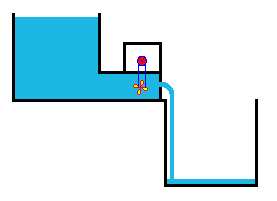
we can compare an electrical circuit to a pair of deposits connected through a pipe. In the electrical circuit, the energy comes from a battery, and it circulates through an electric wire as a flow of electrons. In our example, the energy is the water stored in the upper deposit, which circulates through a pipe. In an electrical circuit the electric energy carried by the electrons is used to do some job, like lighting a bulb, heating a resistance or activating a buzzer. This job is represented by the resistance. The resistance is measured in ohms. In our example, the water that flows from the first deposit moves a turbine connected to it. The small gap that lets out the water after the turbine represents the resistance. |
  |
 |
The intensity, or current, in an electric circuit
is the number of electrons per second that reach the end of that circuit.
Instead of counting up to 6 trillion electrons, we say that the current in an electric circuit
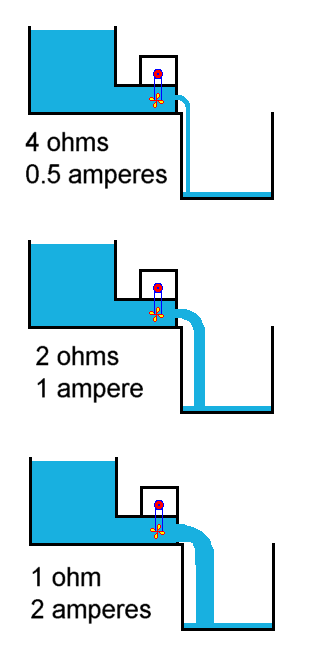
is 1 ampere, or 1-amp. In our example with a deposit of water, the intensity or current is the amount of water that passes through the gap every second. The size of the gap represents the resistance: the bigger the resistance is, the less water can pass through that obstacle, so the intensity is inversely proportional to the resistance. Similarly, in an electrical circuit a higher resistance means that fewer electrons can pass through it every second, so the intensity of the current is smaller. In the first circuit on the left, a big resistance (4 ohms) means that the current is small (0.5 amperes). When we have a bigger gap, the resistance decreases, and the intensity increases. In the third circuit, the resistance is minimum, and the current is maximum. That means that the water will flow faster (and the deposit will become empty faster, too). |
|
Finally, in an electrical circuit, the difference between the negative and positive poles of a battery is called
the voltage, and it is measured in volts. The voltage
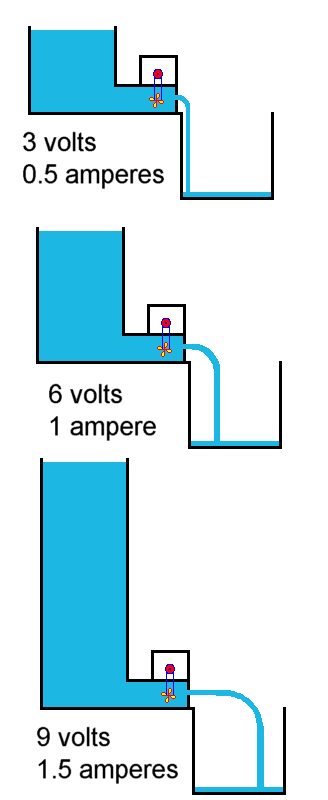
of a battery represents the energy stored in it. In our example, the potential energy stored in the first deposit depends on the amount of water it contains. If we want the water to last longer, we need a larger deposit. We can imagine deposits of varying height: in a higher deposit there is more potential energy stored in the water, but as the pressure is higher, the amount of water that flows through a gap the same size is larger, too, so the current is directly proportional to the voltage. This means that if we replace the battery in a circuit with a battery that has double the voltage of the first one, the current (i.e., the number of electrons per second) will double, too, so voltage and current are directly proportional. To summarise:
From this formula we can deduce the other two:
|
 |
|
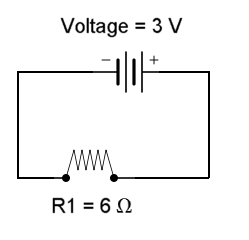
In the circuit on the left, the voltage is 3 volts, and the resistance
is 6 ohms, so we can calculate the current: I = V / R I = 3 / 6 I = 0.5 Amps. |
Go on to power and energy consumption.
JJCC