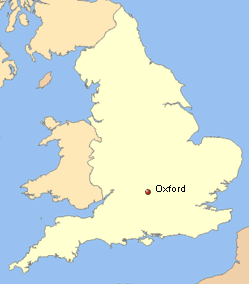
Oxford is a city in the south of England. Oxford's latitude and longitude are 51°45'07 N 1°15'28 W. It has more than 150,000 inhabitants.
|
Oxford is a city in the south of England. Oxford's latitude and longitude are 51°45'07 N 1°15'28 W. It has more than 150,000 inhabitants. |
|
| It is 50 miles from London; it takes 2 hours to drive from London to Oxford. Also, it has got railway station and an airport (recently they have changed its name to London Oxford Airport, which does not make people in Oxford very happy). |
|
|
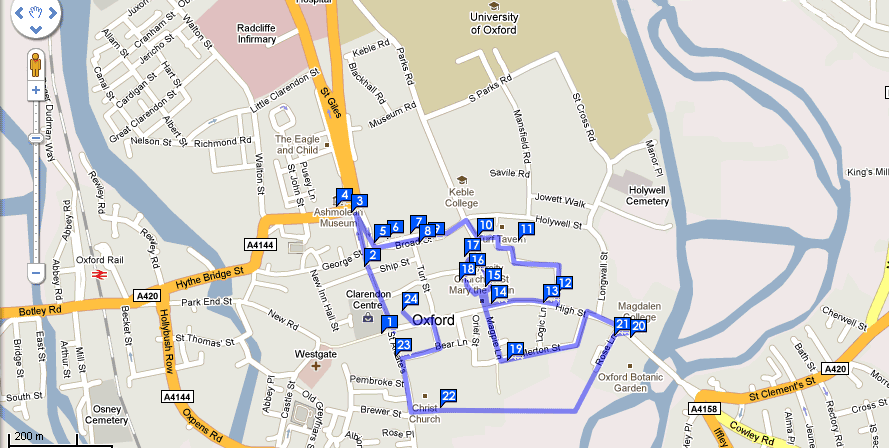
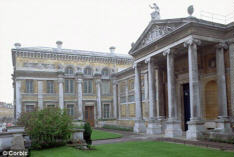
An important place is the Ashmolean Museum (number 4 in the map), which is the oldest museum in Great Britain.
The entrance is free. There are other museums, such as the Museum of Oxford. |
|
The Bodleian Library is a very old library in the city centre (number 17 in the map).
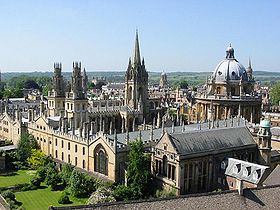
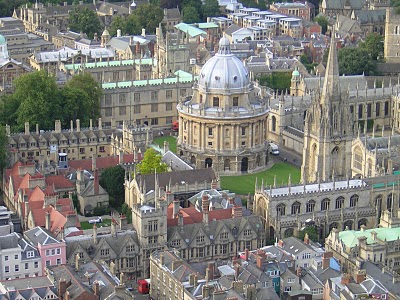
The Radcliff Camera (in the photograph on the right) is part of this library. Oxford also has a Covered Market (number 24 in the map) and a botanic garden. |
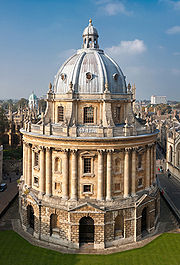
|
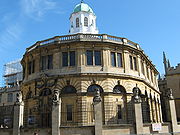
| In Oxford there are also many theatres, such as the Sheldonian Theatre (number 8 in the map). |
|
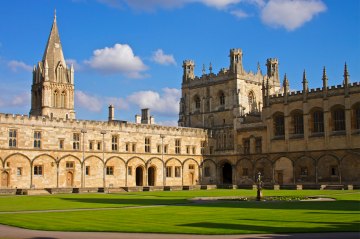
There is also a beautiful cathedral, Christ Church (number 22 in the map). It is also a college of the University of Oxford. |
|
|
HISTORY Oxford was founded in the 9th century. In 1009 the Danes burned Oxford. By the time of the Norman Conquest in 1066 there were probably around 5,000 inhabitants in Oxford; at that time it was a large and important town: London only had about 18,000 inhabitants. In 1142 Oxford was burnt again during a civil war. |
|
The university at Oxford was founded in 1167. In the 12th and 13th centuries Oxford was a manufacturing town, specialising in cloth and leather.
However from the 14th to the 17th centuries manufacturing declined, and Oxford was economically dependent on the university:
the students provided a large market for beer, food, clothes and other goods.
In 1542 Oxford was made a city and was given a Bishop. In 1651 the first coffee house in England opened in Oxford. Coffee was a new drink at that time but it soon became popular. A railway from Oxford to London was built in 1844. Oxford airport opened in 1938. |
|
 | Today the main industries, which started in the early 20th century, are car manufacturing and making vehicle parts as well as publishing. There is now a biotech industry in Oxford, too. The current population of Oxford is 149,000. |