 |
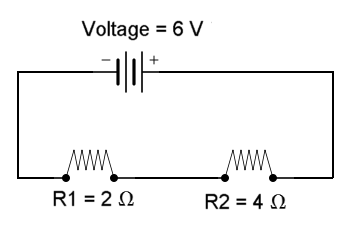
In a series circuit, all the elements are connected one after the other (see the circuit diagram on the left),
so if there are three bulbs connected by one wire, and one of the bulbs stops working, the circuit is open
and the other lights go out, too. The drop in the current after each resistance accumulates, so that the current in the final part of the circuit is much smaller because the effects of the two resistances are added. Look at the circuit in the picture below. |
|
Problem: The voltage is 6 volts. The resistance is 2 + 4 = 6 ohms What is the current flowing through the circuit? How much electricity will this circuit use up?
P = V • I = 12 • 1 = 12 watts. The current is 1 amp, and the circuit will use 12 watts hour (that is to say, the consumption will be 12 watts every hour). |
| With the first resistance only, the current would be 6 / 2 = 3 amps; with the second resistance only, the current would be 6 / 4 = 1.5 amps. That means that by using a series circuit and increasing the resistance, we are using less energy, because the intensity is lower. |
JJCC