Activity 6 : “Photosynthesis” |
Videoclip projection: "Photosynthesis"a) Read and translate the text before watching the video.b) Watch the videoclip with the help of the transcription next to it.c) Answer the questions. |
Photosynthesis is the process that most plants go through to make food. Plants get the raw materials (= materia prima) needed for photosynthesis from the soil (= suelo), the air, and the sun.
When it rains, water gets absorbed into the ground. Plants take in the water, along with minerals from the soil, through their roots. In their roots, plants have tubes. These tubes, or veins, bring water and minerals from the soil to their leaves. Leaves take carbon dioxide from tiny pores, on the underside (= envés) of the leaf.
Now that we have water and carbon dioxide in the leaf, are we ready for photosynthesis? Wrong! We're missing the key ingredient. Let's see the sun now, please. Now it gets really interesting.
It is in the leaves of the plant that most of the action takes place. If we look at the leaf under a microscope, we see a layer of cells. Inside these cells are tiny nodules called chloroplasts. Chloroplasts contain a special chemical product called chlorophyll. It is chlorophyll, by the way, that gives plants a green colour.
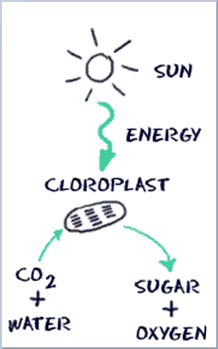
When the light energy from the sun is captured by the chloroplast, it is stored in stacks of thycaloid membranes. It is in these membranes that the chemical reaction of photosynthesis takes place. Chlorophyll increases the speed of this process.
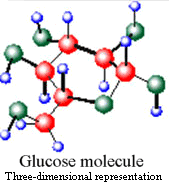
Let's take a look at this reaction. The absorbed light energy from the sun is used to join water and carbon dioxide to form glucose, or sugar. The glucose is then distributed throughout the plant as food. Oxygen is a product of this reaction which the plant doesn't need, and it's released back into the air.

And that is how most plants prepare food for themselves.
a) The products derived from photosynthesis are .............................. and .............................. .
b) How do plants use them?