Index
=>
Click to listen
Kalenda Maya
Show all questions
<=
=>
How many centuries do the Middle Ages cover?
?
3rd - 12th
?
5th - 15th
?
12th - 15th
?
1st - 21st
Who controlled the artists in the Middle Ages?
?
The goverment.
?
Kings.
?
The church.
?
The people.
What is the name for religious music in the Middle Ages?
?
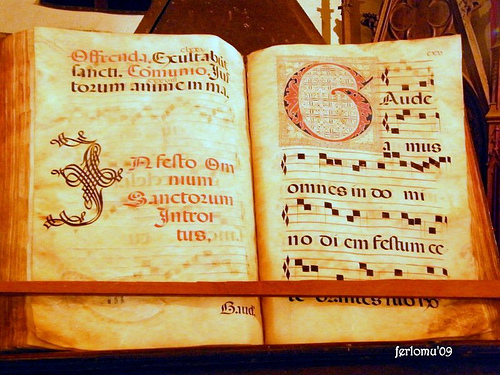
Plainsong.
?
Cantiga a Santa María.
?
Plainchant.
?
Love song.
Which of these characteristics belong to the Gregorian chant?
?
Monophonic
?
Vocal music
?
It has got time signature.
?
It has got measure.
Gregorian chant is named after Pope Gregory I, who...
?
composed all the chants currently in use.
?
was credited by medieval legend with having created it.
?
had his name put on the first printed edition.
?
wrote the texts for the chants.
The church modes are...
?
different from the major and minor scales in that they consist of only six different tones.
?
different from the major and minor scales in that they consist of only five different tones.
?
like the major and minor scales in that they consist of seven different tones.
?
completely different from any other form of scale.
The aristocratic composer-poets of northern France were the...
?
troubadours.
?
trouvères.
?
Meistersinger.
?
jongleurs.
Love was a main topic of secular song among all except the...
?
troubadours.
?
trouvères.
?
Minnesinger.
?
All of the above sang about love.
Secular song in Germany...
?
was written in French, the language of the nobility because of the Norman Conquest.
?
was influenced by the music of the troubadours but was written in German.
?
was written in Latin only.
?
was never written down.
In which language did the troubadours write and sing songs?
?
Latin.
?
Occitan (langue d’Oc).
?
Old French (langue d’oïl).
?
Galician-Portuguese.
Jongleurs were...
?
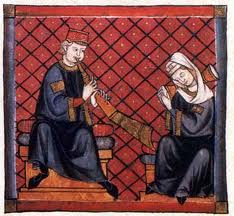
travelling entertainers who juggled as well as sang.
?
female troubadours.
?
students who sang secular songs in Latin.
?
vielle players hired for their virtuoso skills.
Where are Canticles of Holy Mary from?
?
France.
?
Germany.
?
Spain.
?
England.
What language were the Canticles of Holy Mary written in?
?
Latin.
?
Occitan (langue d’Oc).
?
Galician-Portuguese.
?
Old French (langue d’oïl).
In what period were the Canticles of Holy Mary written?
?
Renaissance age.
?
the reign of Alfonso X El Sabio.
?
Baroque age.
?
Classical age.
The theme of the Cantigas is...
?
love.
?
life.
?
the Virgin Mary.
?
religion.
How many Santa Maria Cantigas remain?
?
180
?
1580
?
420
?
415
The earliest surviving treatises and examples of polyphonic music date from the ... century.
?
ninth
?
tenth
?
twelfth
?
thirteenth
The chant melody that served as the foundation for a polyphonic composition is commonly called its...
?
cantus firmus.
?
vox organalis.
?
discant.
?
perfection.
The first composer of polyphonic music whose name we know was...
?
Franco of Cologne.
?
Léonin.
?
Pérotin.
?
Pierre de la Croix.
A style of organum in which both voices move in modal rhythm is called...
?
parallel.
?
discant.
?
florid.
?
modal.
The Ars Nova, or new art, of the fourteenth century differed from older music in that...
?
a new system of notation permitted composers to specify almost any rhythmic pattern.
?
the subjects were all secular.
?
there was no syncopation.
?
the music emphasized homophonic texture.
The Notre Dame Mass by Guillaume de Machaut was...
?
written for three voices without instrumental accompaniment.
?
written for the Cathedral of Notre Dame in Paris.
?
the first polyphonic treatment of the mass ordinary by a known composer.
?
all of the above.
The center of polyphonic music in Europe after 1150 was...
?
Paris.
?
Rome.
?
Reims.
?
London.
The foremost composer of fourteenth-century France was...
?
Guillaume de Machaut
?
Hildegard of Bingen
?
Charles V
?
Perotin
OK
Index
=>