Do you remember how in maths language the minus sign (—) often does not mean "less", it means "the opposite"? Well, in maths language the multiplication sign ( • ) very often means "times"; in fact, that is the word we use to read this sign: 3 • 4 = three times four. So, we can express this problem in two different ways using maths language:
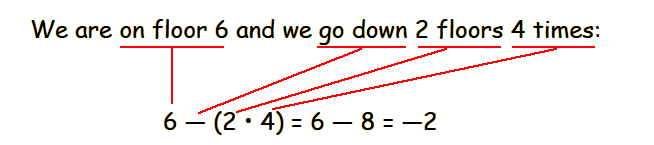
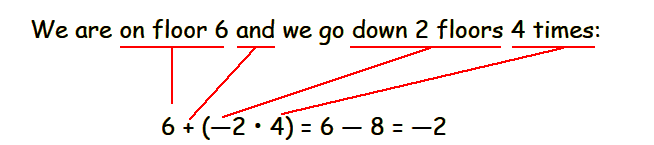
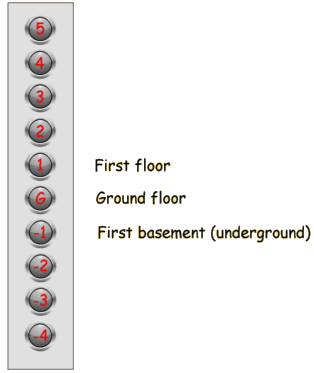
Solution: you end up on the 2nd basement.
|
PROBLEM: Their parents give a boy £15 at the end of June because his grades are so good,
and he wants to buy a £3 ice-cream every day for a week to celebrate.
How much money does he need to borrow from his grandparents? Translation into maths language:  SOLUTION: He borrows £6 from his grandparents. |
Now, can you calculate the solution to these problems? You can use arrows to "translate" the data in the problems into maths language as in the previous examples.
- A shepherd has 150 sheep and he sells 6 sheep every day for two weeks. How many sheep does he have left?
- An engineer uses 2 pounds of steel every day to build motor pieces. If there were 15 pounds in the store,
how much steel is there left after 6 days?
- A man who weighs 245 pounds is on a diet on his doctor's orders, and he loses 2 pounds every week. If he continues with this diet for 6 months, how much will he weigh? (Estimate 52 weeks per year).
JJCC